The same as the formula, packaging is vital for a shoe care brand. It is the first physical contact with the customer, so it has a direct impact on the brand image, user experience, and profits.
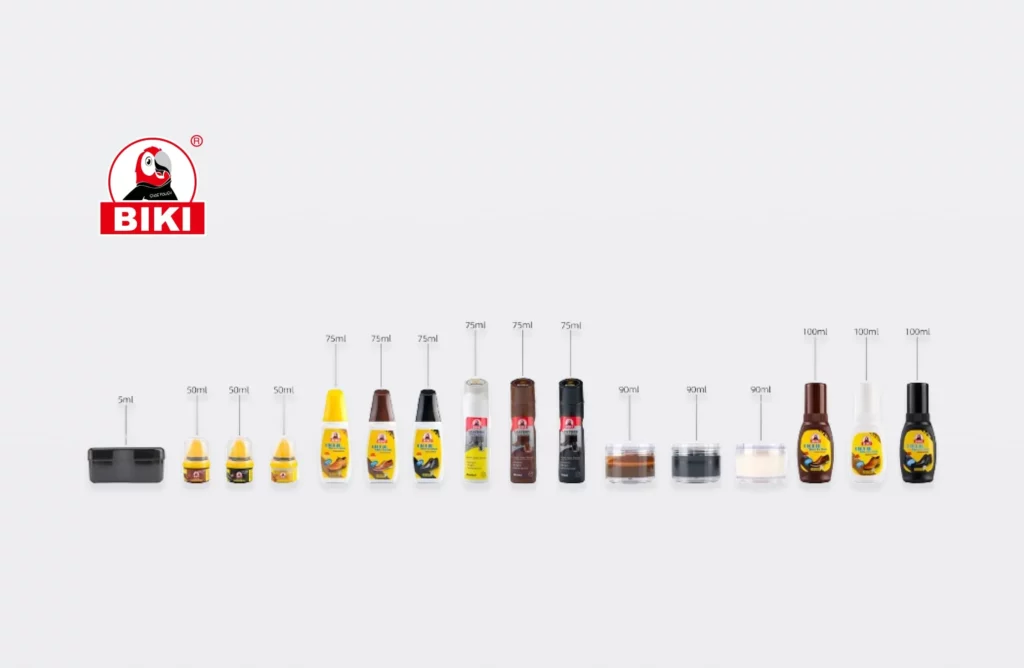
Starting with a private label shoe care brand or expanding an already existing line, the right bottle size and dispenser selection is a core choice that defines your position in the market. This decision should be taken with a partner who has extensive market knowledge. We, at BIKI, are proud of our versatility, offering a wide variety of shoe care packaging solutions to meet the needs of the customer, starting from sample sizes to bulk packaging.
This guide provides you with a 60ml, 100ml, and 200ml bottles’ business uses. Then we will look at types of dispensers so that you can choose wisely and strategically.
Size and Market Strategy
Choosing a bottle dimension is not simply about logistics; it is a principal part of your product and marketing plan. Different volumes meet diverse business needs, address various customer segments and selling circumstances.
Below is the main summary of how the corresponding bottle size pairs with specific market goals.
| Volume of the Bottle | Primary Use Case | Target Market | Benefits | Drawbacks |
|---|---|---|---|---|
| 60ml | Travel, Trial, Promotion | New Customers, Travelers | Low cost, TSA-friendly, encourages trial | Low perceived value, higher cost per ml |
| 100ml | Standard Retail | Everyday Consumers | Best value perception, max carry-on size | Standardized, less differentiation on size |
| 200ml | Value, Professional Use | Heavy Users, Families, Professionals | Lowest cost per ml, builds loyalty | Higher shipping costs, larger shelf footprint |
The 60ml (2oz) Bottle
This is a small size that has been made the ambassador of your brand and is therefore built to reach out and for promotional purposes. Its primary function is to attract new customers.
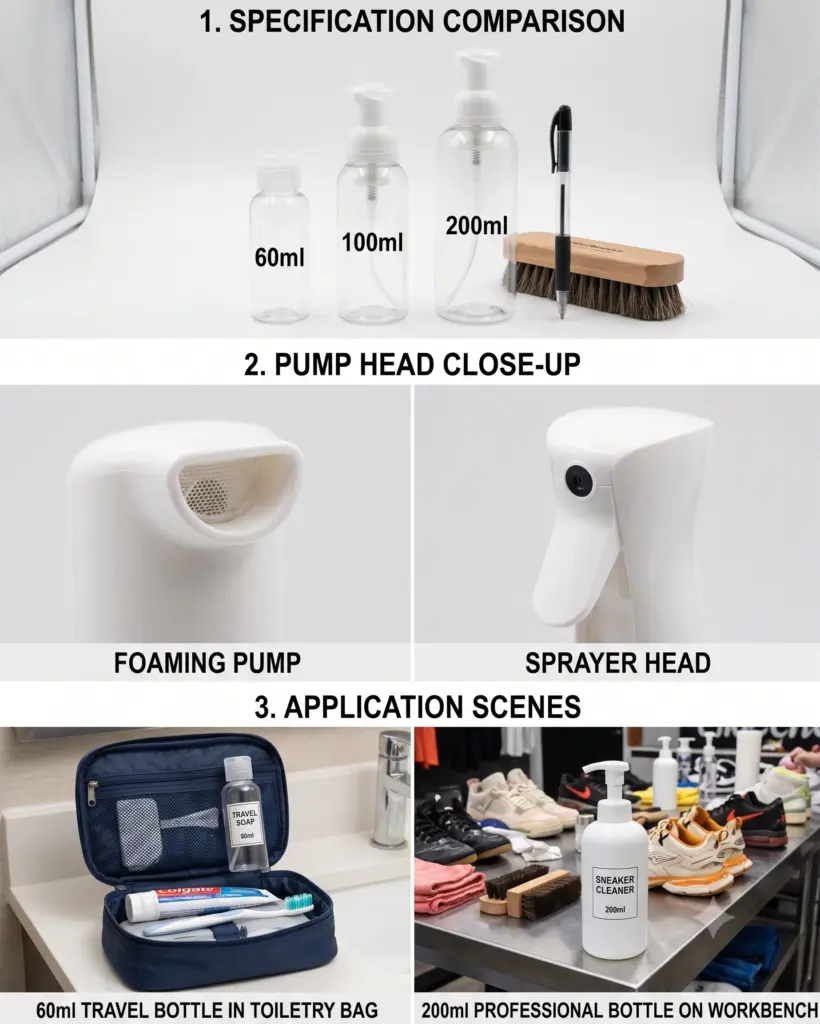
- Use Cases: The 60ml bottle is suitable for travel kits, promotional giveaways, sample programs, starter sets, and gift-with-purchase campaigns.
- Business Analysis: The lower cost-per-unit allows for wider distribution, which in turn drastically reduces the customer’s financial obstacle to trying your product. It is a great format to experiment with new formulas or to enter into new markets with little risk.
- Shipping Considerations: Its very low weight and small size are responsible for the low shipping cost, so it’s a very efficient solution for online orders and large promotional mailings.
- Travel Advantage: This size is below the TSA liquid limit for air travel, which is 100ml. Marketing your product as “travel-safe” is one of the major benefits that can be had apart from its practicality for customers on the move.
The 100ml (3.4oz) Bottle
The 100ml bottle is the identified commercial standard. It is the right balance of value proposition, retail price, and customer convenience.
- Use Cases: This is the size typically used for a standard retail product marketed separately and it has been the only product that is sold in a premium care kit while it was a bestseller online.
- Business Analysis: This size is big enough for several weeks of regular use, yet the consumer feels compelled to repurchase often. It has been the standard size for many premium custom shoe polish bottles and it has also been the standard book for liquid cleaners, thus creating an expectation in the customer’s mind.
- Travel Advantage: Having a weight of precisely 3.4oz, this is the largest possible “carry-on friendly” size approved by the TSA. It’s a prime marketing point for the brands, which are aimed at frequent travelers, or for those who want to maximize product volume.
The 200ml (6.8oz) Bottle
This bottle is the most profitable, lasting the longest, and most commonly used professional option. It aims to the frugal and heavy user category.
- Use Cases: This size is ideal for family-size value packs, professional use by sneaker cleaners and shoe repair shops, and as a bulk option for refilling smaller bottles. It can also anchor a budget-tier product line.
- Business Analysis: It offers the lowest cost per milliliter, a strong value proposition that can drive purchase decisions for smart shoppers. It is also a great tool for building customer loyalty through refill programs, which align with growing customer demand for sustainability.
- Shipping Considerations: The increased weight and volume directly impact shipping costs, which must be factored into your pricing model. In a retail environment, its larger size requires more shelf space, a key consideration when negotiating displays with retailers.
A Technical Dispenser Guide
The dispenser acts as a link between your customer and your formula. The suitable powerhouse raises the product, making it smooth and effective for a user. The wrong decision may result in feelings of frustration, loss, and a bad brand picture.
Foaming Pump Dispensers
Foaming pumps are made for soft and accurate applications, changing a liquid formula into a thick, fluffy foam.
- Best For: Water-based shoe cleaners, suede and nubuck shampoos, and cleaners for delicate materials like canvas or mesh.
- Technical Details: These pumps work by mixing the liquid product with air in a special chamber when pressed. This creates a stable foam that prevents over-wetting of sensitive materials, reduces product waste, and allows for targeted application with a brush or cloth.
- Pros: It offers a luxurious user experience, provides precise application without drips, and works without using aerosol propellants.
- Cons: Foaming pumps generally cost more than other dispensers. They are not suitable for solvent-based formulas or products with high thickness.
Fine Mist Sprayers
Fine mist sprayers are built for even, wide coverage, so they distribute the product in a consistent pattern over a large surface area.
- Best For: Water-proofing sprays, shoe deodorizers, quick-clean mists, and protective coatings.
- Technical Details: The main feature of a fine mist sprayer is the design of its nozzle. It is the only part that is capable of breaking the liquid into fine droplets, creating an aerosol-like pattern without the need for propellants. This is of great importance for those products that require an even coat on a surface for the best possible results.
- Pros: This dispenser type is a real champion because the surface treatment it gives is incomparable and the time that it saves is plenty. It works best with low-viscous, water-thin liquids.
- Cons: It could accidentally get overspray on areas that are not supposed to be, which is a drawback for its precision in spot cleaning. Also, it may run into issues clogs due to the use of thicker conditioners or cream-based formulas.
Standard Lotion Pumps
Dispensing thick creams and lotions that cannot be sprayed or foamed, lotion pumps are the real champions.
- Best For: Shoe creams, leather conditioners, polishes, and gel-based cleaners.
- Technical Details: The mechanism uses a piston and spring system to draw and dispense a set amount of a thicker product. The correct matching of the pump’s output (measured in ml per pump) to the product’s intended use is the secret to good portion control.
- Pros: They are absolutely dependable for thick formulations, assure the correct dispensing to minimize waste, and also, do not allow any undesired product to stay in the bottle contaminating the next one.
- Cons: Lotion pumps are not advisable for watery, thin liquids. It may also be hard for the user to get an empty bottle which can make level some product left in the bottle.
A Procurement Framework
Sourcing your packaging properly necessitates a tactical plan that intertwines costs, customization, and supply chain reliability. Here is a plan for procurement managers and brand founders.
Material Selection
Your bottle’s material not only affects its characteristics but also its aesthetic and chemical compatibility. Of the two types frequently used, PET and HDPE are above all.
PET shows the best clarity among different materials which makes it the best for showing off your product’s color and consistency. HDPE is tougher, usually not see-through, and presents a higher level of chemical resistance; hence, it is more widely used for more aggressive formulas.
Brands that focus specifically on sustainable practices have the option of choosing from PCR versions of the materials mentioned above. Their availability is becoming more common and they act as a differentiating factor in the market.
The Role of MOQs
MOQ means Minimum Order Quantity. The Minimum Order Quantity is a significant element in your procurement strategy.
Our usual suggestion for startup brands is that although high MOQ can mean lower per-unit costs, it will have a tie-up of capital and increase inventory risk. A partnership with a supplier that has flexible MOQs is more promising and will make you grow thereby enabling you to test products and manage cash flow more properly.
The Creation of Custom Appearance
Customization makes a regular bottle become a unique brand property. The possibilities are far more than just a simple label.
- Color Matching: The bottle and dispenser pieces can be custom colored to imitate the exact color needed in your brand guidelines.
- Labeling & Printing: Decide on direct silk-screen printing if you want a premium and durable finish, or use high-quality adhesive labels that offer complex, full-color graphics.
- Molding: In case of high-volume brands that want to differentiate themselves, it is another possibility to create a full custom shoe polish bottle shape. This will require a pretty serious investment in the tool but will definitely be worth it since no one else can have such a unique item.
Supply Chain and Logistics
A dependable supply chain is a must. When you are looking for a supplier, remember, the unit price is not all that matters.
Take a look at the production lead times, the cost of international shipping, and the supplier’s quality control documents. For example, a slow packaging process may affect your entire production line, and a single defective bottle could ruin your company’s reputation.
The Future of Your Brand
The ideal shoe care packaging option is a rational mix of market strategy, user experience, and procurement facts. Your selection is a direct manifestation of your brand’s aspirations and commitment to quality.
To recap the strategic positions of each volume:
- 60ml is for customer acquisition and market entry.
- 100ml is for mainstream retail performance and perceived value.
- 200ml is for building loyalty via value and professional use.
Selecting the correct packaging necessitates the collaboration of specialists and a versatile production partner. If you are keen on formulating a packaging scheme that matches your brand’s objectives, we are at your service. Just reach out to us today for project discussions.